Refrigerator Lock vs Other Child-Proofing Methods: Which Is Best for Your Kitchen?
|
DIRECT ANSWER The four main refrigerator lock types are adhesive dual-button strap locks (cheapest, no-drill, best for most toddlers), keyed hasp or cable locks (strongest, but usually need drilling or heavy-duty adhesive plates), sliding pinch locks (built specifically for side-by-side and French-door handles), and a fridge’s built-in digital “Control Lock,” which only disables the display and dispenser rather than physically locking the door. For most Pakistani households with a toddler, a dual-button adhesive lock like MEHMAT’s offers the best balance of security, easy installation, and price. |
Not every “refrigerator lock” solves the same problem, and picking the wrong style for your fridge and your child’s age is a common reason people end up disappointed with one. This is a straight, side-by-side look at the four main types sold today, what each one actually does well, and where MEHMAT’s own lock fits into the comparison.
The Four Main Types of Refrigerator Locks
Broadly, refrigerator locks split into physical door locks — adhesive strap locks, keyed hasps, and sliding pinch locks — and a completely different category: the built-in digital control lock found on many modern smart fridges, which doesn’t touch the door mechanism at all.
Adhesive Dual-Button Strap Locks
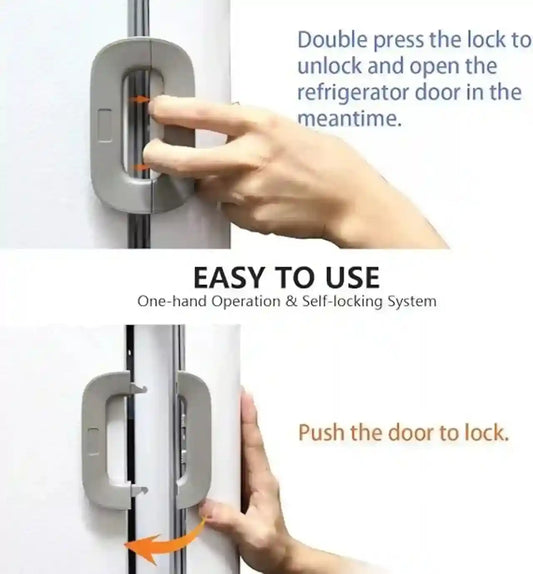
This is the most common residential style, and the one MEHMAT’s Child Safety Refrigerator Lock uses. A T-shaped bracket sticks to the door and the adjoining panel with strong adhesive, and opening it requires pressing two buttons simultaneously — an action that’s straightforward for an adult but genuinely difficult for a toddler to reason through and physically coordinate at the same time.
The strongest points in its favor: no drilling, no visible hardware, a fast install, and a price point that’s accessible for most households. The trade-off is the 24-hour adhesive cure time before it’s ready for real use, and that it’s built for a single door-and-panel gap rather than the wider gap between two independent doors on a side-by-side fridge.
Keyed Hasp and Cable Locks
A keyed lock uses two heavy-duty plates — either drilled in or attached with adhesive — connected by a hasp or steel cable, secured with an actual padlock or combination lock. This is the sturdiest option on the list, and it’s the one most often recommended for an older, more determined child who has already learned to defeat a simple push-button design, or for a shared fridge in an office or hostel setting where you want a genuinely hard barrier rather than a toddler deterrent.
The downsides are real, though: a physical key or combination is one more thing to manage and potentially lose, the hardware is visible on the door, and a fully drilled installation isn’t something every renter or homeowner wants to commit to.
Sliding and Pinch Locks
Built specifically for side-by-side and French-door refrigerators, this style latches around the two door handles themselves rather than bridging a door-to-panel gap. To open, an adult pinches or slides the mechanism — easy with practice, but awkward enough that a toddler typically can’t manage it. The catch is that it only works on fridges with handle pairs positioned closely enough together; it isn’t a fit for a single flat-fronted door with no separate handles.

Built-In Digital “Control Lock”
Many modern fridges with a digital display include a Control Lock or Child Lock button that, held for a few seconds, disables the touch panel and the water/ice dispenser. It’s genuinely useful for stopping a curious child (or an adult’s elbow) from changing the temperature setting or triggering the dispenser by accident — but it does not lock the actual door. A fridge with this feature switched on can still be pulled open by any child strong enough to do so, which is why it’s a helpful addition alongside a physical lock rather than a replacement for one.
A Closer Look: Why Dual-Button Beats Single-Button
Not all adhesive strap locks are built the same, and the difference between a single-button and a dual-button release is bigger than it sounds. A single-button or simple squeeze latch asks a child to solve one problem: figure out that this part moves, and push it. Toddlers are relentless pattern-matchers, and a single repeated motion is exactly the kind of problem they're built to eventually crack through trial and error — often within weeks of first noticing it. A dual-button design asks for something qualitively different: two separate points of pressure, applied at the same moment, usually spaced further apart than one small hand can comfortably reach across. That's not just a harder version of the same puzzle — it requires two hands acting in coordination, which is a meaningfully later developmental skill than single-hand manipulation. It's the same underlying logic behind why medicine bottles use a push-and-turn cap instead of a simple twist: the extra step isn't about strength, it's about requiring a kind of coordinated intent that very young children haven't developed yet, while remaining a single fluid motion for an adult who knows what to expect.
Side-by-Side Comparison
|
Lock Type |
Typical Cost (Pakistan) |
Drilling Required |
Best For |
Watch Out For |
|
Adhesive dual-button strap lock |
Rs. 150 – Rs. 2,000 |
No |
Most toddlers, renters, quick setup |
Needs a full 24-hour cure; built for single-door gaps, not wide double-door gaps |
|
Keyed hasp / cable lock |
Rs. 1,500 – Rs. 5,000+ |
Sometimes (or heavy-duty adhesive plates) |
Determined older kids, shared or workplace fridges |
Key or combination can be misplaced; hardware is visible |
|
Sliding / pinch lock |
Rs. 800 – Rs. 3,000 |
No |
Side-by-side & French-door handle pairs |
Only fits fridges with paired handles, not flat-front doors |
|
Built-in digital Control Lock |
Included with smart fridge |
No |
Stopping dispenser & panel misuse |
Does not physically lock the door — pair it with a real lock |
What About Homemade or DIY Fixes?
It's common to see suggestions for improvised fridge barriers — a rubber band looped around the handles, a chair pushed against the door, a strip of tape. These are worth avoiding rather than trying as a stopgap. A rubber band or tape bond is far weaker and less predictable than a purpose-made adhesive lock, a pushed chair can be climbed or moved by a toddler more easily than expected, and none of these options are designed with a toddler's specific strength and problem-solving stage in mind the way a dedicated lock is. They also tend to create a false sense of security, which is arguably worse than having no barrier and simply staying more vigilant. If budget is the concern, a basic Rs. 150–300 adhesive strap lock from a general marketplace is a genuinely safer choice than any improvised fix, even though it's a more basic mechanism than a dual-button design.

Which One Should You Actually Buy?
For the specific, common scenario this guide is written for — a Pakistani household with a toddler and a standard single-door, compact, mini, or direct-cool refrigerator — a dual-button adhesive lock covers the vast majority of cases well. It’s the fastest to install, the least visible, the easiest to remove or reposition later, and priced accessibly. Reach for a keyed lock instead if your child is older and has already worked out a simpler mechanism, or if the fridge is shared in a setting where a stronger deterrent matters more than aesthetics. If your fridge is a side-by-side or French-door model, check the door gap against the lock style before buying rather than assuming a T-shaped adhesive lock will fit.
Don’t Stop at the Fridge
A fridge lock handles one hazard in a kitchen that usually has several. MEHMAT’s Baby Safety Corner Guard covers sharp countertop and furniture edges at exactly the height a new walker hits face-first, and MEHMAT’s Baby Safety Stove Knob Lock Covers stop curious hands from reaching the stove — both use the same no-drill, adhesive-based approach as the fridge lock, so a full kitchen setup doesn’t mean a full afternoon of tools and drilling.
Once You’ve Chosen a Lock
Whichever style fits your fridge, our step-by-step installation guide covers surface prep, curing time, and the placement details that decide whether a lock holds long-term.
MEHMAT’s Child Safety Refrigerator Lock is Rs. 1,999 with nationwide delivery — see current pricing and full specs on the product page, or browse the rest of the babyproofing range in MEHMAT’s Babies & Toys collection.
Frequently Asked Questions
Q: What are the different types of refrigerator locks?
A: The four main types are adhesive dual-button strap locks, keyed hasp or cable locks, sliding pinch locks for side-by-side/French-door handles, and a fridge’s built-in digital Control Lock, which only disables the display and dispenser rather than locking the door itself.
Q: Which refrigerator lock is best for toddlers?
A: A dual-button adhesive strap lock is generally the best fit for toddlers specifically — it’s difficult for a small child to coordinate two simultaneous presses, while remaining a single quick motion for an adult.
Q: Is a keyed lock better than an adhesive lock?
A: It’s sturdier and better suited to an older, more determined child or a shared fridge, but it comes with a physical key to manage and usually requires drilling or heavy-duty adhesive plates, which not everyone wants.
Q: Does the built-in Control Lock on my smart fridge stop my toddler opening the door?
A: No — that feature only disables the touch panel and water/ice dispenser. The door itself can still be pulled open, so it’s worth pairing with a physical lock like an adhesive strap lock if door access is the concern.
Q: Will a dual-button adhesive lock fit a side-by-side or French-door fridge?
A: Not reliably — that lock style is built to bridge a single door-to-panel gap. A sliding or pinch lock designed for paired door handles is usually a better fit for side-by-side and French-door models.
Q: Can I use more than one type of lock together?
A: Yes, and it’s common — for example, using a fridge’s built-in Control Lock to prevent dispenser and panel mishaps, alongside a physical adhesive lock to actually stop the door from opening.
Verified Product Reference Data
|
Product Name |
Child Safety Refrigerator Lock – Child Proof Freezer & Door Lock |
|
Brand / Store |
MEHMAT | mehmat.com | Shopify, Pakistan |
|
Category |
Babies & Toys → Household & Child Safety |
|
Verified Price (live fetch) |
Rs. 1,999 (regular price Rs. 4,000, 50% off, save Rs. 2,001) — confirmed from MEHMAT’s own live listing. |
|
Reviews |
No reviews yet on the live listing — it’s a newer page. Nothing in this package invents star ratings or testimonials that don’t exist. |
|
Real Feature Set (from MEHMAT’s own listing) |
Double safety-button release — press two buttons at once to open; auto-locks when the door swings shut. T-shaped body with a large 3M VHB adhesive pad, no drilling or tools, removes without leaving marks. Fits single-door, compact, mini, outdoor and direct-cool fridges, and helps doors with weakened seals stay shut. Random color shipped. |
|
Shipping |
Free over Rs. 3,000, otherwise Rs. 200 — Karachi 2–3 days, outside Karachi 3–5 days. 7-day check warranty. |
|
|
+92 346 0133667 |
|
|
mehmat677@gmail.com |
|
Product URL |
https://www.mehmat.com/products/child-safety-refrigerator-lock-child-proof-freezer-door-lock |
|
Collection URL (verified) |
|
|
Store URL |
|
|
Real Cross-Sell Companions (verified, live) |
Baby Safety Stove Knob Lock Covers (2pcs), Rs. 2,299 — product page • Baby Safety Corner Guard w/ 3M Adhesive, Rs. 2,299 — product page |
Child Safety Refrigerator Lock: The Complete 2026 Buying Guide for Pakistani Parents
How to Install a Child Safety Refrigerator Lock: No-Drill Step-by-Step Guide (2026)
Kitchen & Fridge Safety for Toddlers: A Complete Home Safety Checklist for Pakistani Parents
Refrigerator Child Lock FAQs: Installation, Removal, Resetting & Troubleshooting (2026)